01 / The Brief
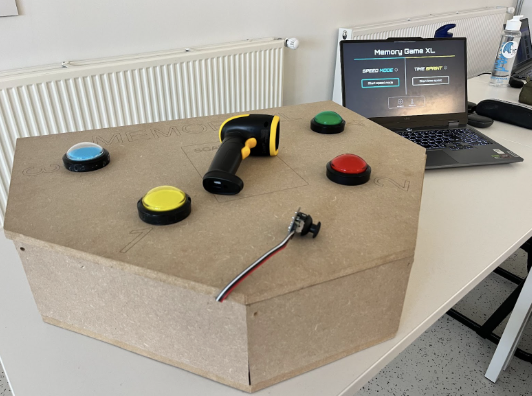
Memory XL is an innovative and interactive version of the traditional memory game in which players rely not only on their memory, but also on their speed and strategy. The game is played in teams or individually and challenges participants to find as many pairs as possible within a limited time by scanning physical tiles. Using large wooden tiles, light signals, and wireless barcode scanners, the classic memory game is transformed into an active and social experience where teamwork and speed are crucial to winning.
Tech Stack //
Technical Breakdown
Technically speaking, we’ve set up a direct socket connection between the Raspberry Pi and the frontend. I built the frontend (together with a teammate) with a focus on responsiveness: as soon as a GPIO pin receives a signal from a pushbutton, it’s immediately sent to the web interface. In doing so, I paid close attention to the component-level connections and the interface design, ensuring that the user notices no delay whatsoever between the physical action and the digital response. The electronics were selected and soldered in such a way that signal transmission to the frontend is stable and error-free.
02 / The Challenge
The assignment was to design and produce a large-scale physical Memory Game as a team. The challenge was twofold: on the one hand, making informed choices regarding electronics (sensors, cabling, and microcontrollers) to build a durable and responsive object. On the other hand, we had to develop a digital extension (website or app) that brings the physical hardware to life through real-time data and user interaction.
03 / The Concept
Memory Game XL is an interactive installation that combines physical activity with cognitive training. The concept is based on a “phygital” approach: the tactile satisfaction of large push buttons combined with the modern features of a linked web app. The physical object serves as the controller, while the app acts as the dashboard for profile management, statistics, and competition.
04 / The Solution
Within the team, I was responsible for the website design and the integration between the hardware and the frontend. We developed a unique interaction in which each physical memory tile is equipped with a unique barcode. By using a barcode scanner as an input device, we capture the scanned data and link it directly to the correct pairs in the code. I ensured that the frontend processes these scans in real time, providing the player with a seamless experience when matching the physical tiles on the digital interface.